
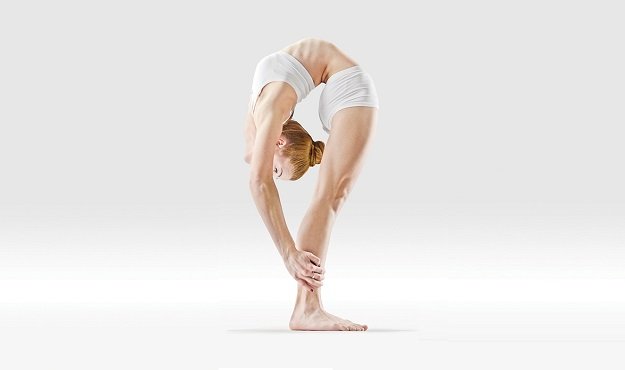
Challenge your balance, strength, and flexibility with the most intense back bend of them all: Full Wheel Pose.
Full Wheel Pose (Tiriang Mukhottanasana) – also known as Reverse Facing Intense Stretch Pose or Intense Backbend Stretch Pose – is one of the most advanced back bend poses in yoga. This pose increases spinal flexibility, strengthens the core and leg muscles, and offers an intense stretch for both the spine and the abdominal muscles, including the psoas. It is most commonly found in the Ashtanga yoga series, but may also appear in Hatha or Vinyasa sequences. It is an energizing and heart-opening pose, and also promotes stability and grounding, while stimulating awareness and focus.
Full Wheel Pose is a very challenging pose, and should only be attempted under the guidance of a qualified instructor. Those who are new to the pose may wish to practice near a wall for balance, or have a partner nearby to help spot them in and out of the pose.
If you are new to this pose, you may practice with your feet hip-width apart for stability until you are comfortable moving in and out of the pose. Be sure to activate your leg muscles by pressing your feet firmly into the ground, and focus on lifting your kneecaps towards your thighs.
This pose requires a lot of flexibility, so those with limited flexibility, as well as seniors or women who are pregnant may want to sit this one out. Those with a hernia, or who suffer from vertigo, glaucoma, or any type of back or spinal injury should avoid this pose altogether.
How to Do Full Wheel Pose:
- Start by standing tall in Mountain Pose with your feet together and hands in Prayer or Namaste mudra at the heart center. (Students who are just learning this pose can keep their feet hip-width apart.) Distribute the weight evenly on both feet, engaging the muscles of your legs. Roll the shoulders back and down, opening the chest. The palms are softly pressed against each other. Lengthen your spine, reaching the crown of your head towards the sky.
- To begin, activate the core and push the navel into the spine. Inhale, lift the ribs away from the hips and slowly send your pelvis forward. Arch your back slightly and look up without compressing the neck. The hands are still in Namaste at the heart center. Keep your legs straight and leg muscles active.
- Slowly let gravity open your spine, and at the same time, be very conscious of engaging your back muscles.
- Slowly extend backwards. Once you see the yoga mat, inhale and straighten your arms behind. Open the palms and breathe here in Raised Arms Backbend Pose B, creating a nice sense of space. Let gravity open your shoulders.
- Finally, with a soft bend in the knees, open your palms to face them toward the floor. Exhale, reach down, and catch hold of your respective ankles with your hands, one after the other. You can also hold just behind or below the knees if that’s as far as you can reach (see these modifications here). Once you’ve grasped your ankles, straighten your legs and arms.
- Stay here in Trianga Mukhottanasana for about six breaths or as per the body’s capacity, fixing your gaze up or behind. Breathe slow and deep, allowing the chest and abdomen to expand with the breath.
- Pose Tips: Make sure your shoulders rotate so that the elbows don’t move outwards. Let your pelvis move forward with a strong foundation to support the weight. Inhaling, press into your feet, pushing your hips and chest away from the ground. Straighten your arms and legs as much as possible, creating a deeper arch with your back. Keep your gluteus, core, and thighs engaged to support this deep backbend. Keep your neck relaxed and your head hanging between your arms with your gaze toward behind or the sky.
- To release, inhale and slowly rise to re-align in Mountain Pose. The head should be the last thing to come up.
- After completing the pose, release to the mat and relax in Child’s Pose or Savasana.
Learn More at Tummee.com…
Image Source: MrYoga.com


