
The seventh limb of yoga is often misunderstood. Here’s what dhyana really is, what it isn’t, and how to achieve it…
Article Summary:
- Dhyana is not something you do — it’s a state you arrive at through the consistent practice of dharana (concentrated focus) and meditation.
- As the seventh limb of Patanjali’s eight-limbed yoga path, dhyana is the bridge between focused concentration and the ultimate state of samadhi, or enlightenment.
- B.K.S. Iyengar described dhyana as the moment when “the flow of concentration is uninterrupted” — a subtle but profound distinction from ordinary meditation.
- Most modern yogis practice asana and pranayama without ever exploring the deeper limbs — but dhyana is where the real transformation begins.
- Keep reading to discover exactly how dharana dissolves into dhyana, and why the concept of Samyama may be the most important thing you’ve never heard of in your yoga journey.
Dhyana is one of the most misunderstood and most transformative steps in all of yoga — and chances are, you’ve already brushed the edges of it without knowing.
Most people assume meditation and dhyana are the same thing. They’re not. Meditation is what you practice. Dhyana is what you enter. It’s a state of being — a seamless, uninterrupted flow of awareness — that arises when your meditation practice deepens beyond effort.

Image from www.wholeharmonyyoga.com.
Dhyana Is Not What Most People Think Meditation Is
Here’s where most explanations get it wrong. Dhyana is routinely translated as “meditation,” and while that’s not entirely incorrect, it’s dangerously incomplete. Meditation — the act of sitting, focusing the mind, withdrawing from distraction — is the vehicle. Dhyana is the destination.
Think of it this way: when you sit to meditate and consciously direct your attention to your breath or a mantra, that’s active practice. That’s dharana — the sixth limb of yoga. But when concentration becomes so sustained, so fluid, that the effort behind it disappears entirely, you’ve crossed the threshold into dhyana. The meditator and the act of meditating begin to merge. That effortless, continuous absorption is what separates dhyana from every other form of mental training. For those interested in exploring the previous stage, pratyahara is an essential practice to understand.
Where Dhyana Sits Within the 8 Limbs of Yoga
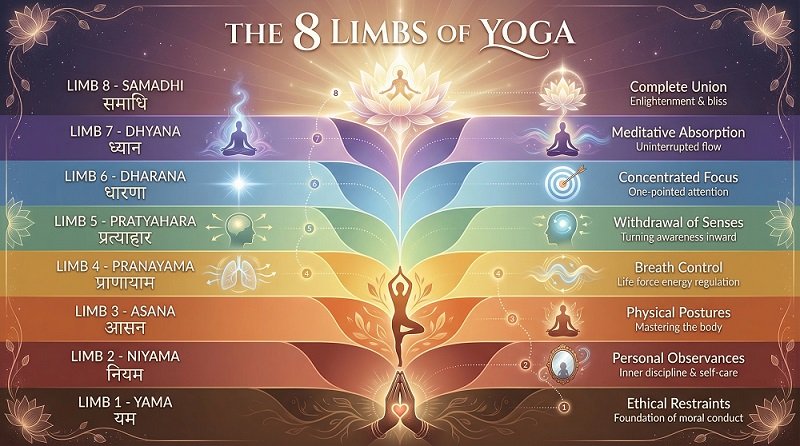
Patanjali’s eight-limbed path — known as Ashtanga yoga — is a complete system for living and awakening. Dhyana occupies the seventh position, nestled between dharana (concentration) and samadhi (enlightened absorption). To truly grasp why dhyana matters, it helps to see exactly where it falls:
| Limb | Sanskrit Name | Meaning |
|---|---|---|
| 1st | Yama | Ethical restraints |
| 2nd | Niyama | Personal observances |
| 3rd | Asana | Physical postures |
| 4th | Pranayama | Breath control |
| 5th | Pratyahara | Withdrawal of the senses |
| 6th | Dharana | Concentrated focus |
| 7th | Dhyana | Uninterrupted meditative absorption |
| 8th | Samadhi | Complete union / enlightenment |
Everything from asana to pranayama builds the physical and energetic foundation that makes the inner limbs — including dhyana — accessible. Without that foundation, sustained meditative absorption remains out of reach for most practitioners.
The Role of Pratyahara and Dharana as Stepping Stones
Before dhyana can arise, two critical transitions must happen. First, pratyahara — the withdrawal of the senses — quiets the constant stream of external input pulling the mind outward. Then dharana channels that quieted mind into a single point of focus. These two limbs are absolutely essential prerequisites. Without pratyahara, the senses keep dragging the mind away. Without dharana, there’s no thread of concentration to deepen into dhyana.
How Dharana Dissolves Into Dhyana
Picture this: you’re seated, eyes closed, focusing on the natural rise and fall of your breath. At first, your mind wanders — to your to-do list, a conversation, a sound outside. You notice, return, refocus. That returning and refocusing is dharana doing its work.
But then something shifts. The gaps between distractions grow longer. The effort of returning becomes lighter. Eventually, you’re simply with the breath — not watching it, not analyzing it, not managing it. There is no sense of “you” observing the breath. There is only the breath. That seamless continuity of awareness, free of the observer-observed split, is dhyana. It’s not something you manufacture. It’s what dharana naturally becomes when practiced long enough.
Samyama: When Dharana, Dhyana, and Samadhi Unite
In the Yoga Sutras, Patanjali introduces a concept called Samyama — the simultaneous, integrated practice of dharana, dhyana, and samadhi together as one unified process. Samyama is considered a powerful inner tool, a way of directing complete, undivided consciousness toward any object of awareness. It’s not a technique you schedule into your morning routine; it’s the natural culmination of years of dedicated inner practice, where the last three limbs stop being separate steps and become one fluid movement of consciousness.
What the Yoga Sutras Actually Say About Dhyana
Patanjali addresses dhyana with characteristic precision in the Yoga Sutras. He isn’t poetic or vague — he’s surgical. The sutras frame dhyana as the direct outgrowth of dharana, not a separate practice to be learned, but a state to be recognized when concentration has matured.
Yoga Sutra 3.2: “Tatra pratyaya ekatānatā dhyānam” — “The uninterrupted flow of the mind toward the object of concentration is dhyana.”
This single sutra says everything. The word ekatānatā is key — it means “one-stretchedness” or unbroken continuity. Not intense focus. Not willful concentration. A continuous, unbroken stream. The moment you’re straining to concentrate, you’re still in dharana. When that strain dissolves, and only the flow remains, dhyana has arrived.
Yoga Sutra 3.2: The Uninterrupted Flow of Concentration
What makes Sutra 3.2 so significant is what it doesn’t say. It doesn’t say dhyana is a technique, a duration, or a posture. It describes a quality of attention — specifically, attention that has become self-sustaining. This is why you cannot force dhyana. Forcing creates tension, and tension interrupts the flow. The path to dhyana is through removing obstacles, not adding more effort.
Patanjali’s View on Effort vs. Effortlessness in Dhyana
This is where many serious practitioners hit a wall. The paradox of dhyana is real: you must practice consistently and with great intention, yet the state itself cannot be grasped. Patanjali understood this completely. The following qualities characterize the shift from effortful dharana into effortless dhyana:
- The sense of “trying” to focus gradually disappears
- The boundary between the meditator and the object of meditation softens
- Time perception alters — sessions that feel like minutes may last much longer
- A quiet, stable joy arises without any identifiable cause
- The mind stops producing reactive commentary on what it perceives
None of these are goals to chase. They are signposts — indicators that the conditions for dhyana have been cultivated through faithful, patient practice.
The Real Benefits of a Consistent Dhyana Practice
The benefits of dhyana reach far beyond stress relief or a few quiet minutes in the morning. When practiced consistently, dhyana begins to reshape the way you experience yourself, your relationships, and reality itself. These aren’t abstract promises — they’re the natural results of training the mind to rest in pure, uninterrupted awareness.
1. Dhyana as the Gateway to Spiritual Liberation
In the yogic tradition, the ultimate goal is moksha — liberation from the cycle of suffering caused by identifying with the ego-self. Dhyana is the most direct path to that liberation available to a practicing yogi. Without dhyana, samadhi remains inaccessible, and without samadhi, the deepest layers of ignorance that cloud our true nature cannot be dissolved. Every minute spent in genuine dhyana is a minute spent loosening the grip of those conditioned patterns that keep us cycling through reactivity, craving, and disconnection.
Image from www.fitsri.com.
2. Sharpened Memory and Mental Clarity
One of the more immediate and tangible benefits that practitioners notice is a marked improvement in cognitive function. When the mind is trained through dharana and dhyana to sustain attention without fragmentation, that capacity carries over into daily life — sharper recall, cleaner decision-making, and a reduced tendency toward mental fog.
- Improved ability to hold complex information without distraction
- Faster recovery when the mind does wander during tasks
- Greater emotional regulation, especially under pressure
- A noticeable reduction in mental chatter throughout the day
- Enhanced creativity arising from a quieter, less cluttered mind
These cognitive upgrades aren’t side effects — they’re direct evidence that the neural pathways supporting sustained attention are being strengthened. Think of it as resistance training for the mind, where dhyana is the heaviest and most productive lift in the entire workout.
Over time, the clarity that emerges from a steady dhyana practice stops being something you access only on the cushion. It becomes your baseline — the default mode of a mind that has learned to stop fighting itself.
3. Release From the Illusion of Separation
According to yogic philosophy, the root cause of human suffering isn’t circumstance — it’s the deeply held illusion that we are separate, isolated selves disconnected from the whole. Dhyana directly addresses this illusion. As concentration deepens into absorption, the felt sense of a rigid boundary between “self” and “other” begins to dissolve. What remains is an experience of interconnectedness — not as a concept, but as a living, breathing reality. This shift alone has the power to transform how you move through the world!
4. A Deeper Connection to Your True Self
Beneath the noise of daily thought, beneath mood fluctuations and identity labels, yogic tradition points to a dimension of self that is stable, luminous, and unchanging. Dhyana is how you access it — not by adding anything, but by clearing away the mental static that keeps it hidden.
- A quiet but unmistakable sense of inner wholeness
- Less dependence on external validation or circumstances for wellbeing
- A growing ability to witness thoughts without being controlled by them
- Natural compassion arising without effort or intention
This isn’t mysticism for its own sake. These are functional, lived changes that practitioners across traditions — from Patanjali’s lineage to modern contemplative science — have documented and described in remarkably consistent terms.
The connection to your true self that dhyana cultivates becomes the most stabilizing force in your life. When the storms of circumstance hit, and they will, the practitioner grounded in dhyana has an inner anchor that nothing external can dislodge.
How to Use the Breath as Your Anchor in Dhyana
The breath is the most accessible and reliable anchor available to any meditator. It is always present, always moving, and deeply connected to the nervous system. Begin by settling into a comfortable seated position and simply observing the natural rhythm of the breath — the expansion of the belly on the inhale, the gentle release on the exhale. Don’t control it. Don’t deepen it. Just watch. This is your entry point into dharana, and with patience, it becomes the thread that pulls you into dhyana. When thoughts arise, you don’t battle them — you simply return, again and again, to the unforced rhythm of breathing, until returning becomes effortless and the flow becomes continuous.

Image from jp.pinterest.com.
Practical Ways to Cultivate the State of Dhyana
Because dhyana is a state rather than a technique, the practical work lies in creating the right inner conditions — removing obstacles, building concentration, and approaching the practice without grasping at results. There is no single method that works for everyone, but there are proven approaches that consistently prepare the ground for dhyana to arise naturally.
Consistency matters more than duration. A 15-minute daily sitting practice maintained over months will take you far deeper than a 90-minute session practiced sporadically. The mind learns through repetition, and the neural grooves of sustained attention deepen only through regularity. Show up every day, even when it feels dry or unremarkable. Especially then.
Why Asana and Pranayama Make Dhyana Easier
The physical and energetic preparation offered by asana and pranayama is not optional for those serious about dhyana — it’s foundational. Asana releases the physical tension that, left unaddressed, creates constant background noise in the body and mind during meditation. Pranayama techniques like nadi shodhana (alternate nostril breathing) and ujjayi (victorious breath) directly regulate the nervous system, shifting practitioners out of sympathetic overdrive and into the parasympathetic states where deep meditation becomes possible. When you sit for dhyana after a thoughtful asana and pranayama practice, the body is already settled, the breath is already refined, and the mind has far less static to wade through.
Using Dharana Techniques to Drop Into Dhyana
Dharana practices are the launchpad. Techniques like trataka (steady gazing at a candle flame), mantra repetition, or visualization of a single internal image all serve the same purpose — they give the mind one thing to hold onto until holding becomes natural. The transition from dharana to dhyana happens when the object of focus stops being something you’re working to maintain and starts being something you’re simply resting in.
Some of the most effective dharana entry points include:
- Mantra repetition — silently cycling a Sanskrit mantra like So Hum (I am that) until the words begin to pulse with their own rhythm
- Trataka — fixed-gaze concentration on a flame or point, training the eyes and mind to stop wandering simultaneously
- Body scan awareness — moving attention slowly and deliberately through each region of the body, cultivating sustained, unbroken presence
- Visualization — holding a vivid internal image steady in the mind’s eye, deepening concentration through sensory detail
What to Do When the Mind Wanders
The mind will wander. Every single session. Even for seasoned practitioners. This is not failure — it is the practice itself. The moment you notice the mind has drifted is actually a moment of pure awareness, a flash of the very consciousness dhyana is cultivating. The problem isn’t that the mind wanders. The problem is the story you tell yourself about it when it does!
When distraction arises, skip the self-judgment entirely and simply return — no commentary, no frustration, no internal lecture about how you should be doing better. The instruction is that simple and that demanding. Each return strengthens the concentration muscle. Over weeks and months of consistent practice, the gaps between distractions grow longer, the returns become lighter, and the continuity of awareness that defines dhyana begins to emerge on its own. You cannot rush this process. You can only show up faithfully and trust that the practice is working even when it doesn’t feel like it.
Dhyana Opens the Door to Samadhi — But You Cannot Force It
Dhyana and samadhi are separated by the thinnest and most uncrossable of lines — and that line is the ego itself. In dhyana, the observer and the observed draw close together, the sense of separation dissolves, and awareness flows without interruption. But the meditator, however subtle, is still present. Samadhi is what happens when even that last thread of “I am meditating” dissolves completely, and only pure, undivided consciousness remains. Patanjali was clear: samadhi cannot be engineered. It can only be invited through the consistent, faithful, ego-surrendering practice of dhyana. Every session of uninterrupted meditative absorption is an open door. Whether samadhi walks through it is not yours to control.

Image from www.jyotirani.com.
Frequently Asked Questions
The seventh limb of yoga raises deep and genuine questions, especially for practitioners stepping beyond asana for the first time. Here are the most common questions answered clearly.
What is the difference between dhyana and regular meditation?
Regular meditation is the active, intentional practice of focusing and refocusing the mind — that’s dharana, the sixth limb. Dhyana is the state that arises when that practice deepens to the point where effort disappears, and awareness flows without interruption. In short, meditation is something you do. Dhyana is something you enter.
The distinction isn’t just philosophical — it’s experiential. In regular meditation, there is always a subtle sense of a “you” doing the meditating, managing the focus, catching the mind when it strays. In dhyana, that management dissolves. The watcher and the watched merge into a single, seamless stream of awareness. Most practitioners oscillate in and out of this state without recognizing it, which is why understanding the distinction matters so much. For a deeper understanding of yoga practices, you might explore this guide on pratyahara, the fifth limb of yoga.
How long does it take to experience dhyana?
There is no fixed timeline, and anyone who gives you one is oversimplifying. Some practitioners catch brief glimpses of dhyana-like states early in their practice. For others, it unfolds gradually after years of consistent work across multiple limbs — asana, pranayama, pratyahara, and dharana all feeding into it. What accelerates the process is not longer sessions but greater consistency, honest self-inquiry, and a willingness to release the need for measurable progress. The moment you stop chasing dhyana is often the moment it becomes available.
Can beginners practice dhyana, or is it only for advanced yogis?
Beginners absolutely belong in this conversation. While deep, sustained dhyana is typically the fruit of a mature practice, the foundational work that leads to it — breath awareness, gentle dharana, consistent seated meditation — is available to anyone from day one. In fact, beginning with the intention to explore the inner limbs, rather than treating yoga as purely a physical discipline, sets practitioners on a far richer path from the very start. Start where you are. The seventh limb will meet you there.
What is the connection between dhyana and samadhi?
Dhyana is the direct predecessor of samadhi, the eighth and final limb. Where dhyana is the uninterrupted flow of awareness toward an object — with the meditator still subtly present — samadhi is the complete dissolution of the subject-object divide. Consciousness stops being directed at something and simply is. Patanjali presents these two limbs as a continuum rather than two separate states, with dhyana naturally ripening into samadhi when the conditions are right and the ego’s grip has sufficiently loosened.
How do the other limbs of yoga support a dhyana practice?
Every limb of the eight-limbed path feeds directly into dhyana’s possibility. The yamas and niyamas — the ethical and personal observances of the first two limbs — reduce the inner turbulence caused by living out of alignment. When the mind isn’t burdened by guilt, dishonesty, or restlessness, it settles far more readily into concentration and absorption.
Asana prepares the body to sit still without discomfort or distraction. Pranayama regulates the nervous system and refines the energy body, making deep states of meditation physiologically accessible. Pratyahara withdraws the senses from external stimulation, creating the internal quiet that dharana and dhyana require. Each limb is both complete in itself and a doorway into the next. None of them are optional detours — they are the path itself.
Featured Image from www.shvasa.com.


