

Here’s why Rajas may be running your life without you even realizing it – & what you can do to find balance…
Article Summary
- Rajas is one of three gunas (alongside Sattva and Tamas) and governs action, desire, and change — it’s not inherently bad, but excess Rajas is one of the most common causes of modern burnout and emotional volatility.
- The Bhagavad Gita directly links Rajasic imbalance to attachment, suffering, and insatiable craving — wisdom that maps surprisingly well onto what we now call chronic stress.
- You can balance Rajas without eliminating it — the goal is to channel it into focused, intentional action rather than reactive, ego-driven doing.
- Diet, breathwork, physical movement, and daily stillness practices are among the most effective tools for bringing Rajas back into equilibrium.
- There’s a specific “balanced Rajas” state that looks and feels different from both burnout and laziness — and most people have never consciously experienced it.
Rajas Is Running Your Life More Than You Think
Rajas can be either your greatest ally or the force quietly burning you out — and most people never stop moving long enough to notice which one it is. Most of us were raised to worship Rajasic energy without ever even knowing its name… Hustle culture, productivity obsession, the relentless chase for more — that’s Rajas in overdrive. The uncomfortable truth is that what feels like ambition and drive can quietly tip into compulsion, anxiety, and a life that’s always in motion but rarely in meaning.
What Rajas Actually Is
The three gunas — Sattva, Rajas, and Tamas — are the fundamental qualities that make up all of nature according to Vedic and Ayurvedic philosophy. Everything in existence, including your thoughts, food, emotions, and daily habits, carries a blend of these three forces. Rajas is the middle guna, the one that bridges stillness and stagnation, and it’s the most dominant energy in the modern world.

Image from www.prathamyoga.com.
Rajas as the Energy of Change and Desire
Rajas is defined by passion, movement, desire, and effort. It’s the force that gets you out of bed in the morning, pushes you to pursue a goal, and ignites the spark of creativity. Without Rajas, nothing in the material world would change — it is, in the most literal sense, the energy of doing!
But Rajas is also the energy of pain when left unchecked. The Vedic texts describe it as a guna that can move in two directions — toward Sattva (clarity and wisdom) or toward Tamas (ignorance and stagnation). Which direction it goes depends almost entirely on how consciously you’re working with it.
Think of Rajas like fire. In the right amount, contained and directed, it cooks your food, warms your home, and lights your path. But fire that spreads without boundaries consumes everything in its path — including you!
“Rajas is characterized by passion and desire, by effort and pain. Its activity can move either toward Sattva — increased spiritual understanding — or toward Tamas — increased ignorance.” For those looking to explore spiritual understanding further, Pranayama techniques can be a helpful practice.
— Vedic philosophical tradition
How Rajas Differs From Sattva and Tamas
| Guna | Core Quality | In Balance | Out of Balance |
|---|---|---|---|
| Sattva | Clarity, harmony, light | Wisdom, peace, discernment | Spiritual bypassing, detachment |
| Rajas | Action, passion, desire | Focused drive, creative energy | Burnout, anxiety, obsession |
| Tamas | Inertia, heaviness, rest | Stability, groundedness, sleep | Lethargy, depression, avoidance |
No guna is inherently superior to another. Tamas gives you the ability to sleep, which is essential. Sattva gives you clear perception. Rajas gives you the momentum to actually live your life. The problem arises when any one guna dominates for too long without the counterbalance of the others.
In the yoga tradition, the ultimate goal is to cultivate Sattva — but this doesn’t mean eliminating Rajas. It means learning to use Rajas in service of Sattva, letting your actions be fueled by clarity rather than craving. For a deeper understanding of these concepts, consider exploring the Guna of Inertia and how it contrasts with Rajas.
Where Rajas Shows Up in the Bhagavad Gita
The Bhagavad Gita addresses the gunas directly and with striking precision. In chapters 17 and 18, Krishna describes how Rajas shapes everything from the food you eat to the nature of your happiness. Rajasic food is described as “oversalted, highly spiced, and causing illness and depression.” Rajasic happiness is described as “overly sensual — sweet in the beginning, poisonous in the end.”
These aren’t abstract metaphors. They’re descriptions of patterns most people recognize immediately — the pleasure that hooks you, the stimulation that exhausts you, the pursuit that never quite satisfies. The Gita frames Rajasic imbalance not as a moral failing but as a navigational error, one that can be corrected through awareness and practice.
Signs Your Rajas Is Out of Balance
Recognizing excess Rajas requires a kind of honest self-inventory that most busy people never pause long enough to do. The signs are often mistaken for personality traits or just “the way life is” — which is precisely why Rajasic imbalance tends to go unchecked for years at a time.
Too Much Rajas: Restlessness, Obsession, and Burnout
When Rajas dominates, the mind rarely settles. You might notice a near-constant mental commentary, an inability to sit still without reaching for your phone, or a persistent sense that you should be doing something even during rest. Emotional volatility is common — impatience, irritability, and a hair-trigger stress response are all signatures of excess Rajas. Physical symptoms often follow: disrupted sleep, tension headaches, jaw clenching, and a body that’s always slightly braced for the next demand.
Too Little Rajas: Stagnation Disguised as Calm
Important distinction: Insufficient Rajas doesn’t always look like obvious laziness. It can look like “going with the flow” while avoiding every decision, or calling passivity “peace” when it’s actually Tamas creeping in under the cover of calm.
Without enough Rajas, life loses its forward momentum. Goals go unpursued, creative energy stagnates, and a heavy, unmotivated quality settles into daily life. This is Tamas gaining ground — and ironically, it often follows a period of Rajasic burnout where the system simply collapsed under its own intensity.
The sweet spot between these extremes is where genuinely productive, joyful, and sustainable living becomes possible. The yoga tradition describes this as Rajas in service of Sattva — action that is engaged, purposeful, and ultimately freeing rather than compulsive.
Learning to distinguish between these states is the first real skill in working with the gunas. Once you can feel the difference between Rajasic restlessness and Sattvic focus, between Tamasic avoidance and genuine rest, the entire framework becomes a practical compass rather than an abstract philosophy.
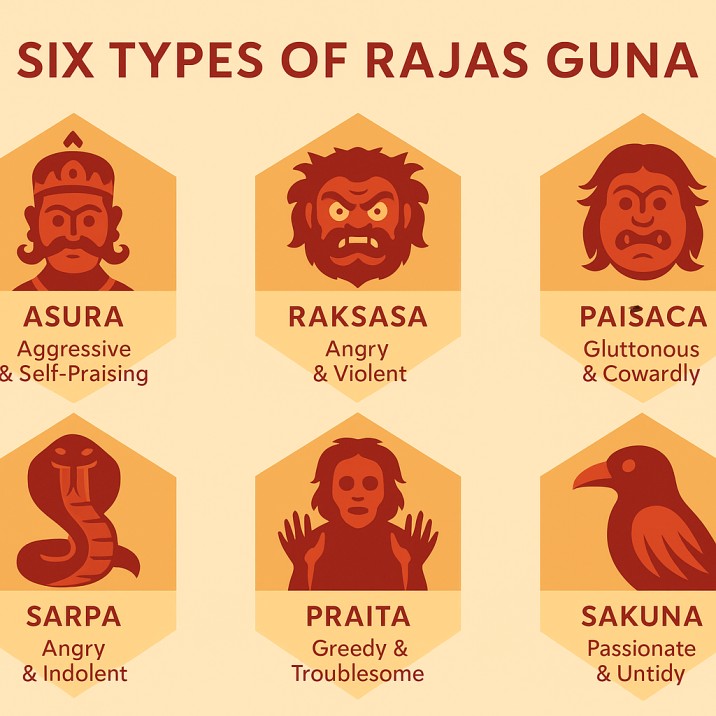
Image from www.fitsri.com.
What Excess Rajas Does to Your Mind and Body
Excess Rajas isn’t just a spiritual concept — it has measurable consequences that show up in how you think, how you sleep, how you relate to others, and how your body holds tension over time.
The Link Between Rajas and Chronic Stress
Chronic stress and excess Rajas are so closely mirrored that it’s difficult to tell where one ends and the other begins. The Rajasic mind is always anticipating the next task, the next problem, the next thing to fix or achieve. This perpetual forward-leaning state keeps the nervous system locked in a low-grade activation response — not quite a full stress alarm, but never truly at rest either.
The body doesn’t distinguish between a genuine threat and a Rajasic thought spiral. Either way, it responds with the same cascade: elevated cortisol, increased heart rate, and a suppression of the body’s restorative functions. Over time, this wears down the immune system, disrupts digestion, and creates a baseline of physical tension that becomes so familiar it stops feeling abnormal.
What makes this particularly tricky is that Rajasic stress often feels productive. The urgency feels like motivation. The mental noise feels like creative thinking. The inability to stop feels like dedication. It’s only when the body finally hits a wall — through illness, exhaustion, or emotional breakdown — that the true cost of unchecked Rajas becomes undeniable.
Ayurvedic practitioners have long pointed to this pattern as one of the root causes of what modern medicine now calls “burnout.” The solution isn’t to stop doing — it’s to change the quality of how you do. Action rooted in clarity and presence (Sattva) produces far less physiological wear than action driven by anxiety and craving (Rajas).
Rajas vs. Sattva in Action: What’s the Difference?
Rajasic Action: Driven by fear of failure, need for external validation, or compulsive desire. Feels urgent, scattered, and never quite enough.
Sattvic Action: Driven by genuine purpose, inner clarity, and presence. Feels engaged, focused, and complete in itself — regardless of outcome.
How Rajasic Imbalance Affects Sleep
Sleep is one of the first casualties of excess Rajas. The Rajasic mind resists the surrender that sleep requires — it keeps rehearsing conversations, planning tomorrow, and generating a mental to-do list at 2 a.m. even when the body is exhausted. This isn’t a sleep disorder in the clinical sense; it’s a guna problem. The energy of restlessness simply hasn’t been discharged or redirected, so it follows you into the bedroom and keeps the system running long past when it should have powered down. Evening practices that deliberately shift the energy from Rajas toward Tamas — grounding foods, gentle movement, reduced screen stimulation, and calming breathwork — are consistently more effective than any sleep supplement for this particular pattern.
Emotional Volatility and Attachment to Outcomes
“Rajasic happiness is overly sensual — sweet in the beginning, poisonous in the end.”
— Bhagavad Gita, 18.38
Emotionally, excess Rajas creates a direct and uncomfortable link between your sense of wellbeing and your external circumstances. When things are going your way, the Rajasic person feels energized and confident. When they’re not, the crash is sharp — frustration, irritability, and an intense sense of dissatisfaction take over almost immediately.
This attachment to outcomes is one of the defining features of Rajasic imbalance, and the Bhagavad Gita addresses it directly. Krishna doesn’t tell Arjuna to stop acting — he tells him to act without attachment to results. That distinction is the entire architecture of balancing Rajas: full engagement with life, minus the compulsive grip on how it all turns out.
Practically speaking, this shows up as the person who is fine when everything is under control and completely derailed when it isn’t. The emotional regulation that Sattva provides — the ability to stay centered regardless of external conditions — is precisely what gets eroded by long-term Rajasic dominance. Rebuilding it takes consistent practice, not just good intentions.
Rajasic Foods That Fuel the Fire
Food is one of the fastest and most direct levers for influencing the gunas. The Bhagavad Gita and Ayurvedic tradition are both explicit about this — what you eat doesn’t just affect your physical body, it shapes your mental and emotional landscape in ways that are both immediate and cumulative. If your diet is heavily Rajasic, no amount of meditation will fully counteract the stimulation you’re consuming three times a day.

Image from www.thewellnesscorner.com.
Common Foods That Amplify Rajas
- Spicy, pungent foods: Chili peppers, hot sauces, heavily spiced curries, and wasabi all stimulate the nervous system and amplify Rajasic heat.
- Heavily salted foods: Processed snacks, cured meats, and restaurant meals loaded with sodium overstimulate the system and drive craving for more.
- Caffeinated beverages: Coffee, black tea, energy drinks, and even some green teas in excess push Rajas into overdrive, particularly when consumed on an empty stomach or in the afternoon.
- Refined sugars and high-glycemic foods: The spike-and-crash cycle of sugar directly mirrors the emotional boom-and-bust of Rajasic imbalance.
- Onions and garlic in excess: Traditionally considered strongly Rajasic in Ayurveda, particularly when consumed raw or in large quantities.
- Alcohol: Initially Rajasic in its stimulating phase, alcohol then pushes the system sharply into Tamas — making it a double imbalance in a single drink.
- Meat, particularly red meat: Dense and stimulating, red meat is considered strongly Rajasic and Tamasic in Ayurvedic dietary classification.
This doesn’t mean every item on this list needs to be eliminated. Context matters enormously in Ayurveda — a small amount of spice in an otherwise grounding meal is very different from a diet built around stimulation and intensity.
The real question to ask is: does this food leave me feeling more scattered, craving, and wired — or more nourished, clear, and settled? That answer, observed honestly over time, is more useful than any rigid dietary rule.
Timing also plays a significant role. Consuming heavily Rajasic foods in the evening — when the body is naturally moving toward rest — is far more disruptive than the same foods eaten at midday when digestive fire and energy naturally peak. Ayurveda has always emphasized when you eat as much as what you eat.
If you’re dealing with significant Rajasic imbalance, reducing the most stimulating items gradually — rather than cutting everything at once, which is itself a Rajasic overcorrection — tends to produce more lasting results. For more insights, explore the three fundamental forces of nature.
How to Adjust Your Diet Without Going Fully Sattvic
A fully Sattvic diet, as traditionally defined, is an aspirational framework designed for dedicated spiritual practitioners and renunciants — not necessarily for someone balancing a career, family, and a full modern life. The practical approach is to shift the ratio: increasing Sattvic foods (fresh fruits, vegetables, whole grains, legumes, nuts, seeds, dairy in moderation, and mild natural sweeteners like raw honey) while gradually dialing back the most intensely Rajasic choices. Small, consistent adjustments to diet create far more lasting guna shifts than dramatic overhauls that can’t be sustained.
A simple starting framework: make one meal per day — ideally breakfast or dinner — as Sattvic as possible. Warm, lightly spiced oatmeal with fruit. A simple kitchari with ghee and mild herbs. A bowl of steamed vegetables with basmati rice. These aren’t deprivation meals — they’re recalibration meals, and their effect on mental clarity and emotional steadiness tends to become noticeable within days.
How to Balance Rajas Through Daily Practice
Diet creates the foundation, but daily practice is where the real work of balancing Rajas happens. The gunas respond to repetition — small, consistent actions compound over time into genuine shifts in your baseline state. A single meditation session won’t rewire a deeply Rajasic pattern, but a daily practice sustained over weeks absolutely will.
The key is working with Rajas rather than against it. Trying to suppress Rajasic energy through pure willpower is itself a Rajasic act — forceful, effortful, and ultimately counterproductive. The practices that work best redirect the energy, give it a container, and gradually train the nervous system to move between activation and rest with more ease and less drama.

Image from www.ayurvedapost.com.
The most effective daily practices for balancing Rajas tend to fall into four categories, and you don’t need to implement all of them simultaneously. Starting with one or two and building from there is both more sustainable and more aligned with the Sattvic approach you’re trying to cultivate.
- Breathwork — to interrupt Rajasic momentum in the moment
- Physical movement — to discharge accumulated Rajasic energy through the body
- Intentional planning — to channel Rajas into focused action rather than reactive doing
- Structured stillness — to build the capacity for rest and presence that Rajas erodes over time
Each of these works through a different mechanism, and together they address Rajasic imbalance at the level of the breath, the body, the mind, and the daily schedule — which is exactly the comprehensive approach the Ayurvedic tradition recommends.
1. Use Breathwork to Interrupt Rajasic Momentum
Breath is the fastest available tool for shifting guna states. Unlike food or lifestyle changes, which work gradually, specific breathing practices can produce a measurable shift in nervous system activation within minutes. For excess Rajas, the most effective techniques are those that extend the exhale, slow the overall breathing rate, and activate the parasympathetic nervous system — the physiological counterpart to Sattvic calm.
Three Breathwork Practices for Excess Rajas:
Nadi Shodhana (Alternate Nostril Breathing): Inhale through the left nostril for 4 counts, hold for 4, exhale through the right for 8. Repeat for 5–10 minutes. Traditionally used to balance the two hemispheres of the nervous system and reduce mental agitation.
Extended Exhale Breathing: Inhale for 4 counts, exhale for 8. No holds required. Simple, accessible, and effective within 2–3 minutes for acute Rajasic spikes like anxiety or irritability.
Bhramari (Humming Bee Breath): Inhale fully, then exhale with a gentle humming sound. The vibration activates the vagus nerve and produces a rapid parasympathetic response — particularly useful before sleep or after a stressful event.
The timing of breathwork matters. Practicing in the morning before the day’s demands begin sets a Sattvic tone that carries forward. Practicing at transitional moments — between work tasks, before meals, or at the end of the workday — prevents Rajasic momentum from building unchecked across the day.
Even two to three minutes of intentional breathing is enough to create a measurable shift. The goal isn’t to achieve a perfect meditative state — it’s simply to interrupt the automatic Rajasic momentum and insert a moment of conscious choice. That gap between stimulus and response is where guna awareness lives, and breathwork is one of the most reliable ways to widen it.
2. Channel Rajas With Physical Exercise
The Ayurvedic principle here is direct: Rajas that isn’t consciously directed will direct itself — usually into anxiety, over-thinking, or reactive behavior. Physical movement gives Rajasic energy a legitimate and productive outlet, discharging it through the body rather than allowing it to accumulate in the mind.
The type of exercise matters as much as the fact of exercising. Intense, competitive, or adrenaline-driven workouts — HIIT training, competitive sports, extreme endurance challenges — can actually amplify Rajas rather than balance it, particularly in someone who is already running hot. The most Sattva-promoting forms of physical movement are those that are rhythmic, connected to breath, and engaged rather than aggressive.
Brisk walking in nature, swimming, cycling at a moderate pace, and yoga — particularly slower styles like Hatha or Yin — are exceptionally well-suited to channeling Rajas constructively. They discharge excess energy without adding more stimulation to an already overstimulated system. The identifying marker of the gunas in your yoga practice, as the tradition teaches, is whether you are genuinely moving forward (Sattva), running in place (Rajas), or losing your way (Tamas).
Morning movement is particularly powerful for Rajasic types. It gives the day’s energy a conscious starting point, provides a healthy outlet for the natural cortisol peak that occurs in the first hour after waking, and sets a tone of engaged-but-grounded that carries through the hours that follow. Even a 20-minute walk taken with deliberate presence — not while listening to a podcast or mentally composing emails — creates a noticeably different quality of awareness for the rest of the day. For a structured start, try this 35-minute morning yoga wakeup flow to enhance your morning routine.
3. Set Intentions Before Action
One of the most practical shifts you can make with excess Rajas is changing what happens in the moment before you act. Rajasic action is reactive — it moves from impulse to execution without a pause. Sattvic action inserts a breath, a question, a moment of clarity between the impulse and the response. This is what setting an intention actually means in a Vedic context: not writing affirmations in a journal, but genuinely asking why before you move.
Before starting a work session, ask: What is the single most meaningful thing I can accomplish in the next 90 minutes? Before a conversation, ask: What quality do I want to bring to this exchange? Before making a decision, ask: Is this coming from clarity or from urgency? These questions aren’t productivity hacks — they’re guna interventions. They shift the driver of your action from Rajasic compulsion to Sattvic discernment, and over time, that shift becomes automatic.
Practically, this looks like a two-minute pause at the start of each day — before the phone, before the email, before the first demand lands. In that pause, you identify the three actions that genuinely matter today and commit to doing those with full presence rather than doing fifteen things reactively. Rajas gets channeled rather than scattered, and the quality of what you produce changes dramatically as a result.

Image from integralyogamagazine.org.
4. Build Stillness Into Your Day
For a Rajasic person, stillness feels unproductive at best and genuinely uncomfortable at worst. That discomfort is the most reliable signal that stillness is exactly what’s needed. The nervous system that has been running on Rajasic fuel for months or years has lost its capacity for genuine rest — it interprets stillness as a problem to be solved rather than a state to be inhabited. Rebuilding that capacity is gradual, and it starts with very small doses of deliberate non-doing.
Start with five minutes. Not meditation necessarily — just sitting without a screen, without audio, without a task. Outside if possible, since natural environments have a measurably grounding effect on the nervous system. Do this at the same time each day, preferably at a natural transition point: after lunch, after work ends, or just before sleep. Consistency matters more than duration here. Five minutes daily for two weeks does more than a single two-hour meditation retreat to rewire the baseline Rajasic pattern.
As the practice stabilizes, extend it gradually. Ten minutes of morning meditation, practiced consistently over four to six weeks, produces observable changes in reactivity, emotional regulation, and the quality of focus during active work — the very qualities that Rajasic overdrive erodes. The tradition is unambiguous on this: regular meditation amplifies Sattvic qualities, and as Sattva grows, both Rajas and Tamas naturally find their appropriate, balanced place in the system. The goal was never to eliminate stillness from a busy life — it was always to make stillness the ground from which all activity rises!
Rajas in Balance Looks Like This
Balanced Rajas is one of the most alive and productive states a person can inhabit — and it’s recognizable because it feels fundamentally different from both burnout and stagnation. You move through your day with genuine energy and focus, but without the frantic edge that characterizes excess Rajas. You can begin a task and complete it. You can rest without guilt. You can pursue a goal without being emotionally hijacked when outcomes don’t cooperate. Your ambition is present and real, but it sits in you rather than driving you. You act, and then you stop — and both the action and the stopping feel natural. That equilibrium, where Rajas serves Sattva and Tamas provides the structure for rest, is not a philosophical ideal. It is a lived, felt, daily experience — and it is absolutely achievable with consistent, conscious practice.
Frequently Asked Questions
The gunas generate a lot of questions when people first encounter them seriously, particularly around how they interact with modern life, Ayurvedic body types, and practical timelines for change. Here are the most common ones, answered directly.
Is Rajas Always Negative in Ayurveda?
Rajas is not negative in Ayurveda — it is essential! Without Rajas, there is no motivation, no creativity, no capacity for change or growth. The Vedic tradition is clear that all three gunas are necessary components of existence. The problem arises specifically with excess Rajas — when the energy of action becomes compulsive, ego-driven, and disconnected from any deeper purpose or awareness.
In fact, the yoga tradition explicitly teaches that Rajas and Tamas should be cultivated in service of Sattva — not eliminated. A person with zero Rajas would be completely inert. The goal is not a Rajasic lobotomy; it is a Rajasic recalibration. Channel it wisely, and Rajas becomes one of your most powerful tools for living a full, engaged, and meaningful life!
Can You Have Too Little Rajas?
Yes — and this pattern is underdiagnosed because it often masquerades as spiritual calm or laid-back contentment. Insufficient Rajas produces a life where days blur together, ambitions go unpursued, and a heavy, unmotivated quality settles into the bones. Decisions feel overwhelming. Creative projects never quite start. The body feels sluggish and the mind foggy. This is Tamas gaining ground in the absence of enough Rajasic fire to keep it in check.
To increase Rajas when it’s deficient, the same dietary and lifestyle levers apply — but in reverse. Mildly stimulating foods, invigorating exercise, cold water exposure in the morning, and activities that require engagement and decision-making all help kindle Rajasic energy when it has gone flat. The key word here is mildly — the goal is to light the fire, not to pour gasoline on it and then wonder why everything’s burning.
What Foods Reduce Excess Rajas?
Sattvic foods are the most reliable dietary intervention for excess Rajas. These include fresh fruits and vegetables (particularly sweet and cooling ones like cucumber, coconut, ripe mangoes, and leafy greens), whole grains like basmati rice and oats, legumes prepared with mild spices, nuts and seeds in moderate amounts, fresh dairy in the Ayurvedic tradition (particularly warm milk with a pinch of cardamom in the evening), and natural sweeteners like raw honey and jaggery used sparingly.
Cooling herbs and spices are particularly valuable: coriander, fennel, cardamom, and fresh mint all have a measurably calming effect on Rajasic heat. Replacing your morning coffee with warm CCF tea — a traditional Ayurvedic blend of cumin, coriander, and fennel — is one of the simplest single dietary interventions available for reducing excess Rajas, particularly first thing in the morning when the nervous system is most impressionable.
What you reduce matters as much as what you add. Gradually dialing back caffeine (especially after noon), processed and highly salted foods, pungent spices in the evening, and alcohol creates a measurably calmer physiological baseline within one to two weeks. The goal isn’t dietary perfection — it’s shifting the overall ratio of what you’re consuming so that Sattvic inputs outweigh Rajasic ones across the course of each day.
How Does Rajas Relate to Vata, Pitta, and Kapha?
The gunas and the doshas are related but distinct frameworks within Ayurveda. The gunas — Sattva, Rajas, Tamas — describe the qualities of the mind and consciousness. The doshas — Vata, Pitta, and Kapha — describe the physiological constitution of the body. They interact, but they don’t map directly onto each other. That said, certain dosha types tend toward specific Rajasic patterns:
- Vata types with excess Rajas tend toward anxiety, racing thoughts, and scattered energy — doing many things at once and finishing few of them.
- Pitta types with excess Rajas tend toward intensity, perfectionism, and sharp irritability — driven, competitive, and prone to anger when goals are blocked.
- Kapha types with excess Rajas present differently — the natural Kapha groundedness initially buffers the Rajasic energy, but when overwhelmed, it can manifest as stubborn, emotional attachment and possessiveness.
Understanding your dosha alongside your dominant guna allows for a much more targeted and effective approach to balancing Rajas. A Vata-Rajasic person needs grounding and rhythm. A Pitta-Rajasic person needs cooling and softening. A Kapha-Rajasic person needs spaciousness and letting go. Same guna imbalance, different expressions, different solutions.
If you’re unsure of your dosha, working with an Ayurvedic practitioner for an initial assessment is worth the investment — particularly if you’ve been dealing with persistent Rajasic imbalance that hasn’t responded to general lifestyle adjustments. The precision of an individualized protocol consistently outperforms a generic one.
How Long Does It Take to Balance Rajas?
The honest answer is: it depends on how long the imbalance has been building. A recent Rajasic spike — triggered by a high-pressure project, a major life change, or a stressful season — can often be meaningfully shifted within two to four weeks of consistent dietary and lifestyle adjustment. The nervous system is responsive, and it doesn’t take long to feel the difference when the inputs genuinely change.
A deeply entrenched Rajasic pattern — one that has been the default operating mode for years or decades — takes longer. Expect a genuine recalibration period of three to six months before the changes feel stable and self-sustaining rather than effortful and maintained. This isn’t discouraging — it’s realistic. The gunas respond to consistency above all else, and the practices that balance Rajas are not difficult. They simply require showing up for them regularly. For those interested in deeper practices, exploring pranayama techniques can also support this balance.
Featured Image from rushiayurveda.com.


