

What is samadhi and how does one attain it? Here’s a comprehensive guide to the 8th limb of yoga…
- Samadhi is the eighth and final limb of yoga as described by the sage Patanjali in the Yoga Sutras — it is the ultimate state of meditative absorption where the self, the mind, and the object of meditation merge into one.
- You don’t reach samadhi overnight. The seven preceding limbs of yoga — from ethical conduct to breathwork to deep meditation — are all preparation for this single, profound state.
- Samadhi exists on a spectrum. From fleeting moments of clarity during meditation to the deepest state of ego dissolution, there are multiple levels — and even beginners can glimpse the earliest stages.
- Hinduism and Buddhism define samadhi differently — understanding both traditions gives you a richer, more complete picture of what this state truly means.
- There is a clear path you can follow to work toward samadhi, built on consistent meditation, pranayama, and the gradual turning inward of your attention.
Samadhi is an important concept for many yogis, Buddhists, Hindus, and other practitioners of Eastern traditions.
Samadhi represents the state of enlightenment or pure consciousness, transcending material concerns and the entrapments of the ego. The concept of samadhi in yoga is often associated with Ashtanga yoga and is believed to be the final step on the path to enlightenment – or the 8th limb of the yogic path.
Most people come to yoga through postures and breathwork, but those practices are just the beginning. The ancient sage Patanjali laid out a complete roadmap for human consciousness in his Yoga Sutras, and at the very top of that map sits samadhi — a state so profound that the mind, the self, and the object of meditation dissolve into one unified experience. If you’ve ever felt a deep stillness during meditation where time seemed to disappear, you’ve touched the edge of it.
Understanding what samadhi truly is can completely transform the way you approach your practice. Those who are dedicated to understanding yoga on a deeper level recognize samadhi not as a distant myth but as a living, reachable dimension of inner experience.

Image from naturemusicmeditation.bandcamp.com.
Samadhi refers to attaining a state of bliss and oneness with the universe and realizing your oneness with the world around you, instead of as a separate being. According to this article,
Samadhi is described as a state of “non-duality” where the self and the world around it are (finally) perceived as one and the same. Effectively transcending the limits of the body, mind, and identity, the aspiring yogi becomes one with everything.
Attaining samadhi is not an easy task, and it requires discipline and dedication. However, it is possible for anyone, meaning, you don’t need any specialized training or qualifications to achieve it. Practicing the 8 limbs of yoga is believed to be one of the best ways to get there – or at least to bring you closer:
Many believe samadhi can only be attained through the mental discipline of yoga… (as in, the eight limbs, not just the physical poses or asanas), but that’s not to say it isn’t accessible to anyone. In theory, the potential is within all of us, and the eight limbs are the most straightforward “steps” to reaching it.
Samadhi Is the Highest State of Consciousness You Can Reach
Samadhi is the pinnacle of yogic practice — a state of complete meditative absorption where individual consciousness merges with universal consciousness. The boundaries between the meditator, the act of meditation, and the object being meditated upon fully dissolve. What remains is pure awareness, untouched by thought, ego, or the noise of daily life.
This is not a metaphor. Across Hindu, Buddhist, and yogic traditions, samadhi is treated as a real, attainable state of being — not a religious concept reserved for monks or mystics, but the natural destination of a sincere, sustained inner practice.
Where Samadhi Fits in the Eight Limbs of Yoga
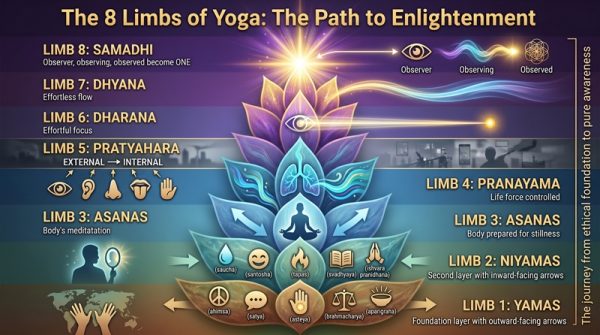
Patanjali’s Ashtanga system — meaning “eight limbs” in Sanskrit — is a structured progression of practices designed to guide the practitioner from the outer world inward to the deepest layers of consciousness. Samadhi doesn’t stand alone. It is the culmination of seven preceding limbs, each one preparing the mind and body for what comes next.
1. Yamas: Your Relationship With the External World
The Yamas are five ethical guidelines governing how you interact with the world around you: non-violence (ahimsa), truthfulness (satya), non-stealing (asteya), continence (brahmacharya), and non-greed (aparigraha). They form the moral foundation everything else is built upon.
2. Niyamas: Your Relationship With Yourself
Where the Yamas face outward, the Niyamas turn inward. These five personal observances — cleanliness (saucha), contentment (santosha), discipline (tapas), self-study (svadhyaya), and surrender to a higher power (ishvara pranidhana) — cultivate the inner character needed to sustain deeper practice.
3. Asanas: Physical Movement and Posture
Most Westerners know yoga almost entirely through asana — the physical postures. But in the context of Patanjali’s eight limbs, asana has one primary purpose: to create a body stable and comfortable enough to sit in meditation for extended periods without distraction.
4. Pranayama: Breath Control
Pranayama is the regulation of breath and, by extension, life force energy (prana). Specific breathing techniques calm the nervous system, sharpen mental focus, and create the internal conditions necessary for deeper states of awareness to emerge.
5. Pratyahara: Withdrawal of the Five Senses
Pratyahara is where the external journey ends and the internal journey begins. It is the deliberate withdrawal of the senses from external stimuli — sight, sound, smell, taste, and touch — so that awareness can fold inward without the constant pull of the outside world. Explore the practice of Pratyahara for yourself to learn more.
6. Dharana: Single-Pointed Concentration
With the senses quieted, Dharana trains the mind to hold its attention on a single point — a mantra, a flame, a chakra, or a concept — without wandering. This single-pointed focus is the direct precursor to meditation. It is the training ground where mental discipline is forged. For a deeper understanding of these principles, explore the sixth limb of yoga and its focus on concentration.
7. Dhyana: Passive Meditation and Stillness
Dhyana is often translated simply as “meditation,” but it is more precisely an uninterrupted flow of awareness toward the object of concentration. Where Dharana requires effort to hold focus, Dhyana is the effortless continuation of that focus — a quiet, steady stream of consciousness moving without strain. For more insights on developing your practice, explore Dhyana practices and how they relate to the seventh limb of yoga.
8. Samadhi: The State of Enlightened Absorption
Samadhi is what happens when Dhyana deepens to the point where the meditator forgets they are meditating. The observer, the act of observing, and the object being observed collapse into a single unified experience. There is no “you” watching anymore — there is only pure, luminous awareness. This is samadhi. To learn more about this concept, you can explore the stages of Samadhi according to the Ashtanga Yoga tradition.
What Samadhi Actually Means
Samadhi is a Sanskrit term that carries a weight no single English word can fully hold. Most translations land somewhere around “union,” “absorption,” or “bliss” — but the lived reality of samadhi goes far beyond any of these words. It is a state in which the fluctuations of the mind, what Patanjali calls chitta vritti, come to a complete stop, and pure consciousness shines through without distortion.
What makes samadhi distinct from ordinary meditation is the complete dissolution of the sense of self. You are not relaxed. You are not focused. You are not even “experiencing” anything in the way you normally would — because the “you” that normally does the experiencing has temporarily stepped aside entirely.
The Sanskrit Breakdown of the Word Samadhi
The word itself gives you a clue about its meaning. Samadhi is derived from three Sanskrit components: sam meaning “together” or “completely,” a meaning “toward,” and dhi meaning “mind” or “to place.” Literally translated, samadhi means “to place the mind completely together” — a total integration of consciousness.
“Yoga is the cessation of the movements of the mind. Then there is abiding in the Seer’s own form.”
— Patanjali, Yoga Sutras, Book 1, Verses 2–3
This etymology is not just poetic — it is instructional. The goal of samadhi is not escape or transcendence in the sense of running away from life. It is the complete gathering of a mind that is normally scattered across thousands of thoughts, worries, and distractions, and bringing it into total, unified stillness.
Understanding this root meaning reframes the entire practice. Every asana, every breath, every moment of dharana is an act of gathering — slowly, patiently collecting the scattered pieces of your awareness and drawing them home.
How do you know if you’re approaching samadhi? According to MindBodyGreen.com, here are a few signs that could indicate you’re making progress:
- a resounding stillness as you go about your day
- a transcendence of basic senses
- a lasting feeling of connection to all
- calm concentration
- the ability to control your sensory intake
How Hinduism and Buddhism Define Samadhi Differently
Both Hinduism and Buddhism use the word samadhi, but they approach it from meaningfully different angles. In the Hindu yogic tradition, as laid out by Patanjali, samadhi is the eighth and final limb of yoga — the destination of the entire Ashtanga path. It represents the union of individual consciousness (atman) with universal consciousness (Brahman).
In Buddhism, samadhi functions as the third division of the Noble Eightfold Path, appearing after pañña (wisdom) and sila (ethical conduct). Rather than being the final goal, Buddhist samadhi is understood as a powerful tool for developing the concentration and clarity needed to achieve enlightenment and liberation from suffering (dukkha).
Within the Buddhist framework, samadhi contains four distinct meditative states called the jhanas — progressive levels of absorbed concentration, each deeper and more refined than the last. This structured, step-by-step model of meditative depth is one of the most detailed maps of inner experience found in any contemplative tradition.
- Hindu Samadhi: The eighth and final limb of Ashtanga yoga — union of the individual self with universal consciousness
- Buddhist Samadhi: One component of the Noble Eightfold Path — deep concentration used as a vehicle toward enlightenment
- The Four Jhanas (Buddhism): Four progressively deeper states of meditative absorption within samadhi
- Shared core: Both traditions agree that samadhi involves the stilling of mental chatter and the transcendence of ordinary ego-driven awareness
What Patanjali Says About Samadhi in the Yoga Sutras
Patanjali dedicates the entire first book of the Yoga Sutras — called Samadhi Pada — to defining and describing this state. In verses 17 through 23, he introduces the concept and its stages, and then in sutras 42 through 51, he defines it with remarkable precision. He identifies two broad categories: samprajñata samadhi, or samadhi with an object of concentration, and asamprajñata samadhi, a higher state in which even the object disappears and only pure consciousness remains.

Image from www.jyotirani.com.
The Levels of Samadhi
Samadhi is not a single switch that flips on or off. It is a spectrum — a progression of increasingly refined states of consciousness that unfold as the practitioner’s practice deepens over time. This is one of the most important things to understand, because it removes samadhi from the realm of the impossibly mystical and places it within reach of any sincere practitioner.
In the Hindu yogic tradition, three primary levels of samadhi are most commonly described, moving from initial absorption with an object all the way to complete dissolution of the individual self. Each stage is both a destination in its own right and a doorway into the next.
- Savikalpa Samadhi: The first stage — absorption with an object of meditation still present in awareness
- Savichara Samadhi: A subtler stage involving absorption with concepts and subtle objects rather than gross physical ones
- Nirvikalpa Samadhi: The deepest stage — complete absorption where the body, mind, and object of meditation merge entirely, and connection to the material world temporarily ceases
Some Hindu yoga traditions also reference sahaja samadhi — sometimes called asamprajnata samadhi — as the ultimate expression of this state, where enlightened awareness is not limited to seated meditation but becomes the natural, continuous background of all experience, even in ordinary daily life. For more insights into meditation practices, explore Dhyana practices in yoga.
Early Glimpses: Fleeting Moments of Clarity
Most practitioners first encounter samadhi not as a dramatic awakening, but as a brief, quiet moment during meditation when the internal dialogue simply stops. Time feels suspended. There is no sense of effort. Something vast and still opens up — and then, just as quickly, the thinking mind rushes back in. These fleeting glimpses are real contact with the earliest edge of samadhi, and they are far more common than most people realize.
Deeper Absorption: Dissolution of the Ego
As practice matures, these moments grow longer and more consistent. The practitioner begins to experience states where the sense of being a separate, bounded self becomes genuinely thin — where the usual inner narrator goes quiet and awareness expands beyond the borders of the individual body and mind. This is the territory of savikalpa samadhi: deep absorption where the object of meditation is still present, but the meditator is no longer standing apart from it.
At this level, the process described by Patanjali as vyutthana — the returning of the mind from samadhi to ordinary waking consciousness — becomes instructive. The mind compares the two states and recognizes the profound difference in quality. This contrast itself becomes a powerful motivation to practice more deeply.
The Highest State: Unity With Universal Consciousness
In nirvikalpa samadhi, the deepest and most complete state, even the object of meditation disappears. There is no longer a meditator, a meditation, or something being meditated upon — only undivided, boundless awareness. The individual self merges with what the Hindu tradition calls Brahman, universal consciousness, and the experience of separation dissolves entirely. Most practitioners who reach this state describe an ineffable sense of peace, wholeness, and bliss that no ordinary sensory experience can approximate.
What Samadhi Feels Like
Language struggles here — and that is not an accident. By definition, samadhi is a state beyond the mind’s ordinary structures, which means the very tools we use to describe experience (concepts, comparisons, language) are the tools that samadhi transcends. What practitioners across traditions consistently report is a profound sense of peace that feels entirely different from relaxation — not the absence of tension, but the presence of something vast and fundamentally whole.
There is often a quality of timelessness, a deep inner joy that arises from no external cause, and a clarity that makes ordinary waking consciousness feel, by comparison, like looking at the world through frosted glass. Coming out of even a brief samadhi state, practitioners frequently report a sense of refreshed aliveness, emotional equilibrium, and a loosening of habitual mental patterns — effects that can carry through hours or even days of daily life.

Image from yachnayoga.wordpress.com.
How to Work Toward Samadhi
The path toward samadhi is not a shortcut — it is a systematic cultivation of the conditions in which the state can naturally arise. No specific technique forces samadhi into existence. What practice does is remove the obstacles: the restlessness, the mental noise, the habitual grasping of the ego that keeps deeper states of consciousness out of reach. The three most direct preparations are a consistent meditation practice, deliberate pranayama work, and the cultivation of pratyahara — the art of turning the senses inward.
Build a Consistent Meditation Practice
The single most important thing you can do to move toward samadhi is to meditate every day — not occasionally, not when inspiration strikes, but with the same regularity you bring to eating or sleeping. Patanjali is explicit about this. In the Yoga Sutras, he identifies abhyasa (steady, committed practice) and vairagya (non-attachment to results) as the two essential pillars of progress. Without consistency, the mind never develops the depth of stillness samadhi requires.
Start with a fixed time and a fixed place. Early morning — before the noise of the day builds — is traditionally recommended because the mind is naturally quieter after sleep. Even twenty minutes of daily seated meditation, practiced with genuine sincerity over months and years, will produce changes in your inner landscape that no weekend retreat can replicate. Choose a single object of focus: a mantra, the sensation of breath at the nostrils, or a simple inner point of light. Depth comes from returning to the same object again and again, not from variety.
As your practice deepens, the transitions between Dharana (concentrated focus) and Dhyana (effortless flow of awareness) will become more recognizable. You will begin to notice when the effort of concentration relaxes into something quieter and more spacious. That threshold — that shift from effort to ease — is the doorway samadhi waits behind. Your only job is to keep showing up until the door opens on its own.
Use Pranayama to Quiet the Mind
Breath and mind are intimately linked — when one is agitated, the other follows. Pranayama practices like nadi shodhana (alternate nostril breathing) and ujjayi (victorious breath) directly calm the nervous system and reduce the mental turbulence that blocks deeper meditative states. Practiced for ten to fifteen minutes before seated meditation, pranayama essentially does the preliminary work of stilling the mind so your meditation can begin from a deeper baseline. Think of it as tuning an instrument before you play — the practice that follows is simply cleaner, clearer, and more likely to touch the edges of absorption.
Image from himalayanyoganepal.com.
Practice Pratyahara to Turn Inward
Pratyahara — the fifth limb of yoga — is the bridge between the outer and inner practices, and it is often the most overlooked. It is the deliberate withdrawal of sensory attention from the external world: closing the eyes, softening the ears, releasing the pull of smell, taste, and touch. Without pratyahara, the senses keep pulling awareness outward, and no amount of meditation technique can fully compensate for that constant leakage of attention.
Simple pratyahara practices include lying in a darkened, quiet room before meditation, using earplugs or a meditation cushion to reduce physical distractions, or beginning your sit with a deliberate body scan that signals to your nervous system that it is safe to withdraw attention from the external environment. Over time, pratyahara becomes less of a technique and more of a natural capacity — the ability to be fully present in the world while remaining rooted in a quiet inner stillness that external circumstances cannot easily disturb.
Samadhi Is a Journey, Not a Destination
Here is the quiet paradox at the heart of this practice: grasping after samadhi is one of the surest ways to push it further away. The ego that wants to achieve samadhi is precisely the structure that samadhi dissolves. The most experienced practitioners across both Hindu and Buddhist traditions say the same thing — samadhi is not something you do. It is something that happens when you have removed enough of the obstacles that were always keeping it from arising naturally. Your practice is not a ladder you climb toward bliss. It is a gradual, patient clearing of the ground so that what has always been present — pure, undivided awareness — can finally be recognized for what it is. Walk the path with sincerity, without fixation on the destination, and the destination has a way of quietly finding you.
However, even if you never achieve true samadhi, many yogis feel the journey in itself is worth something:
Samadhi may not come easy, but anyone can participate in the path toward it. Like any practice, it requires patience, determination, and a degree of detachment from the outcome. Even if someone doesn’t reach Samadhi in this lifetime, the pursuit of enlightenment can still deepen your spiritual life and help you reach a new level of peace and understanding.
Image from kavaalya.com.
Frequently Asked Questions
Here are answers to the most common questions people have about samadhi, drawn from both classical yogic texts and the broader contemplative traditions that have worked with these states for thousands of years.
Is Samadhi the Same as Enlightenment?
Samadhi and enlightenment are closely related but not identical. Samadhi is a state — a profound experience of unified consciousness that can be entered and exited. Enlightenment, in most Hindu and Buddhist frameworks, refers to a permanent transformation of the self in which the misperception of separation is irreversibly dissolved. You can experience samadhi without being enlightened. However, deep and repeated samadhi practice is considered one of the most direct pathways to the permanent shift in understanding that enlightenment represents.
How Long Does It Take to Reach Samadhi?
There is no honest single answer to this question, and anyone who gives you one should be approached with caution. Patanjali himself acknowledges that the timeline varies based on the intensity and sincerity of practice, the practitioner’s accumulated tendencies (samskaras), and factors that go beyond any simple formula. What the tradition consistently affirms is that earnest, daily practice — particularly meditation, pranayama, and ethical living — creates the conditions in which samadhi becomes increasingly accessible over time.
Can Beginners Experience Samadhi?
Yes — in its earliest, most fleeting form. The brief gap between two thoughts, the sudden silence that opens in a meditation session before the mind rushes back in, the moment during a yoga class where you lose all sense of time — these are genuine, if momentary, touches of samadhi‘s outermost edge. Advanced levels of samadhi require years of sustained practice, but the spectrum begins closer to ordinary experience than most people assume. Every sincere meditator has already tasted something of what samadhi is, even if they didn’t have a name for it at the time.
What Is the Difference Between Dhyana and Samadhi?
Dhyana is the seventh limb of yoga and samadhi is the eighth — and the distinction between them is one of degree rather than kind. In Dhyana, there is an uninterrupted, effortless flow of awareness toward the object of meditation, but the meditator is still subtly present as a separate witness. In samadhi, even that subtle sense of the witness dissolves. The meditator, the act of meditation, and the object being meditated upon merge into a single, unified experience. Dhyana is the river flowing steadily; samadhi is when the river meets the ocean and can no longer be distinguished from it.
Do You Need a Guru to Reach Samadhi?
The classical yogic tradition places enormous value on the guidance of an experienced teacher, particularly when navigating the subtler stages of practice. A genuine guru — one with direct experiential knowledge of these states — can recognize where a student’s practice is stuck, correct errors in technique that the student cannot see from the inside, and provide the kind of direct transmission (shaktipat) that some traditions consider essential for awakening deeper levels of awareness.
That said, the Yoga Sutras also describe practitioners reaching profound states through ishvara pranidhana — surrender and devotion to a higher principle — without referencing a human teacher as a strict requirement. What matters most is sincerity, consistency, and the humility to keep learning. A good teacher accelerates and safeguards the journey considerably, but the inner work is always, ultimately, your own.


